

The nervous system
Understanding the human nervous system and the polyvagal theory
Why does it matter so much and how is it relevant to neurodiversity?

I have read a lot about the polyvagal theory (the vagal nerve) and it is fascinating albeit it obviously has a lot of medical terminology that can discombobulate the brain!
I have linked to a useful website above where you can read about it for yourself but it is, to all intents and purposes, the main powerhouse that fluctuates constantly between feeling calm and feeling under threat (whether that’s real danger or just perceived danger).
It has existed since the beginning of time and was vital to the survival of the human race when we lived in caves - it is what saved us from being eaten by a lion; it kept us on high alert for any imminent danger to life. Unfortunately as we have evolved, some of us haven’t managed to shake that age old mechanism and it still exists today in forms that can be very unhelpful and irrelevant. For some, it creeps into our everyday lives even when it’s clearly not needed.
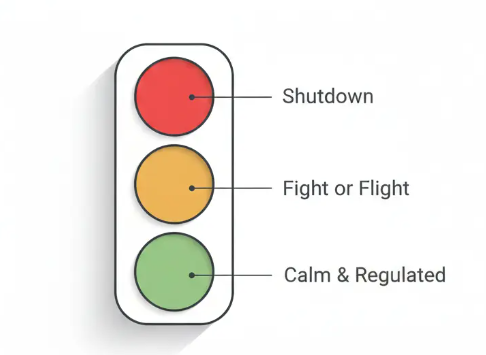
Visualising it as a traffic light, our nervous system is the thing responsible for:
telling us when we are relaxed and calm (the “green zone”);
telling us we have gone into fight or flight (the “amber zone”) by perhaps:
giving us butterflies in our stomach when we have to do something we get nervous about (body’s reaction to perceived danger);
causing our heart to start racing and break out in a sweat when we might accidentally step into the road but don’t see the motorbike coming; that flood of adrenaline that helps us react super quick so we can escape danger (body’s reaction to real danger);
total shutdown whilst the body and brain tries to protect itself (the “red zone”).
Everyone’s nervous system “baseline” will differ
It’s the reason why one person might go through life almost horizontal because their baseline is so low that it takes a lot to trigger their “fight or flight”. It’s in their mental makeup that their nervous system spends most of its time in calm mode (the “green zone”).
Even when it receives a perceived danger signal (for example, giving a speech at a wedding / work presentation etc) or a real danger signal (like, perhaps, almost being run over!) that person’s nervous system has the ability to drop back to calm mode, the “green zone”, in a timely manner.
All is well again!
Conversely another person’s baseline may naturally sit above the “green zone” - it may spend pretty much all of its time in the “amber“ fight or flight area.
It’s not in that person’s conscious control but their body is permanently under perceived threat over lots of every day life experiences and tasks.
“What if there is nowhere to park when I get to the shops?? What will I do??”
“What if I have to use the self service till and it won’t scan my stuff but there is nobody to help?? How will I pay??“
“My washing machine is getting old. I don’t want to use it now in case it breaks down mid cycle and I can’t get my washing out and it all goes mouldy! Now I will worry about that every day until it actually happens!!“
These people are “the worriers”. Their nervous system is what I like to call “a tad wonky” because it processes thoughts as a perceived threat to their person. It’s not able to differentiate between real danger and perceived danger so it reacts the same way to both, causing a state of anxiety for the majority of the time.
Many neurodivergent people spend a lot of time floating around in the “amber zone” of fight or flight. This is why they appear anxious so much of the time.
Some neurodivergent people may sit at the lower end the “amber zone” so they’re pretty well acquainted with the “green zone” and can flip flop between the two. Some might have found that they are able to use exercise, meditation, breath work and other wellbeing activities to stay better acquainted with the “green zone”. A cheer for them because it can help a lot (and I do a lot of them regularly so I can vouch for that!!).
However some people unfortunately spend much of their time nearer the top of the “amber zone” which is closer to the “red zone” of total shutdown. The top of the “amber zone” is indeed an exhausting place to be; it’s a state of high anxiety that feels extremely uncomfortable and frightening. It can often have no boundaries and feel totally out of control. A person in this state may need help to recognise this in their nervous system and seek support but many people just muddle on through life without realising the mechanism behind it all.
Neurodivergent children are no different to their adult counterparts. Many are cognitively wired to live in the “amber zone”. Again, it’s no more a choice than the colour of our eyes. It’s just how we are born.
Both of my girls live in the “amber zone”. H lives higher up than L, but they are both in there, scrambling about every day trying to navigate around their fight or flight response!
Whilst a child’s worries may seem small and insignificant to an adult, those worries are age proportionate. It can be something as simple as not wanting to say hello when a visitor comes to the house; worrying about whether they will have the same hairstyle as their friends at school or worrying about who they will be sat next to at lunchtime that day.
It’s good to remind ourselves of the age appropriate relativity because it’s easy to be dismissive of their feelings in the moment, especially if we just want to quickly “fix” their issue and help to get them past it.
After learning about the nervous system, I also learned about the saying “behaviour is communication”. An anxious child whose nervous system is not serving them well will find it hard to navigate those anxiety provoking thoughts when they keep going into “fight or flight” on a daily basis.
They can’t understand or identify the emotions that they are feeling, why they feel them, or what to do with them. It just feels really uncomfortable. Their body is telling them that there is a threat but they don’t know why or how to stop it. All they know is that it feels horrible. In addition, for many neurodivergent children, sensory processing can massively heighten that threat response.
For some, that internal discomfort may present as a regular tummy ache or headache
For others, it shows up as a fizzy ball of pure uncontrollable anger and argumentative aggression.
They don’t yet have the skills to articulate, so it’s going to come out as behaviour (often resembling defiance) because that’s their only form of communication.
My girls actually differ in their presentation during fight or flight mode
H’s default mode is “fight”. The physical and verbal aggression literally bursts out of her little body like a firecracker. Thankfully only at home and never beyond our front door (she stores it all up behind her mask and releases it all when she gets indoors!).
If we’d been alive in caveman times, she’d be the girl I’d want in my cave! She would also make a great barrister; she can argue her way out of anything!!

L’s default mode has always been “flight”. As a child, she would run away, hide and often cry. Avoidance of anything that might exacerbate her anxiety would be her main coping mechanism.
If we’d been alive in caveman times, she’d be frantically looking to escape through a back door of the cave or desperately trying to find a hiding place, and I’d have been 100% with her!! L calls her anxiety state “the mountain”.

However your child presents their fight or flight mode, one thing is for sure: their ability to receive a parent’s reasoning, logic or counter argument is ZERO. They CANNOT HEAR YOU!! The front part of their brain (pre-front cortex) that deals with reasoning and processing is “offline” while it’s in survival mode.
It took me a long time to learn that and sometimes I still try to reason with H in the moment, I catch myself doing it (we are all only human after all) and I think “Stop! Breathe! She cannot hear you or reason with you. Validate her feelings. Be there quietly, calmly and patiently”.
It took several years (and we are still learning all the time) to remember that staying calm and regulated ourselves, as the parent, is key to co-regulating a child who doesn’t feel emotionally “safe”. Riding the storm with them but being the calm harbour walls, so that we can meet their needs in that storm, will be a life line to our own sanity!
I have also learned, however, that our ability to do that will be directly dependent on how regulated we are to start with. We are also just people, doing our best. It took me ages to master the “tomorrow is a new day” mentality. My husband has watched me fall apart on a number of occasions when I have felt totally defeated in some of H’s most difficult days. I am grateful that we have each other to tag team when H is having a difficult time and melting down.
_________________________________________
I want to take this opportunity to send solidarity to those who are navigating this in a single parent household. I brought L up by myself from when she was two years old to when she was eleven. It.is.hard. When a child’s nervous system is dysregulated and so you are, trying to stay calm in the depths of their storm is not for the faint hearted.
I have had the privilege of receiving some life coaching over recent years from a wonderful woman who once said something to me that was so simple and yet so powerful. She said:
“You are enough”
When the day is long and wobbly, when your child is having a meltdown and you are also dysregulated and exhausted, please try to remember that just being there with your child, holding space for their feelings and letting them know that you will hug them when they come out the other side, means that you are also enough. Doing this consistently will send messages to your child that you are their safe space. When they know that you are there unconditionally, it can have such positive effects on their self-esteem and that, in turn, improves behaviour.
H once said to me a few years ago: “Mummy, I am just dying from the all the love you give me”.
L said to me even more recently: “Mum, you will never know what you have done for me and I am so grateful for the relationship we have now”.
Having a grown up child means I have the benefit of knowing that things can get better. Children can learn to grow and thrive when their environment is right.
L is now a fully fledged adult with her own interior design business. I am so immensely proud of the self-driven, hard-working, dedicated, loyal and beautiful young lady that she has blossomed into.

Take time to:
understand how sensory processing affects your child’s nervous system - make a sensory profile;
understand how the nervous system works so that you can learn to recognise dysregulation before it escalates;
be their safe space if the meltdown occurs (whilst their brain is “offline”).
When you are doing these things, you are enough!
Tips and tricks for nervous system regulation
The first thing a trained professional might suggest to a parent is to teach their child the “zones of regulation”. This type of poster can often be seen on primary school classroom walls. It’s a very good tool to help a child identify and label their feelings and then slowly learn to communicate them. If you don’t have anything like this at home, you may want to consider it? If it’s not engaging enough for your child, try making a bespoke one tailored to their interests. For example, if you have a keen astronomer in your home, invite them to make one with you where each planet represents an emotion. Let them choose which planet corresponds to which emotion and colour them all accordingly. So, they may choose Venus, and colour it red, to convey anger.
Managing our nervous system’s perceived threats (the ones which aren’t real danger but our body responds the same way) takes a lot of practice.
I firmly believe that once you have discovered what works best for your child in identifying and managing nervous system response triggers, you can help them to build a coping framework that can have insurmountable benefits as they grow into adulthood. They’ll have learned an invaluable life skill that will provide ongoing self-support throughout life.
Sensory input
If you are able to, get a sensory profile for your child, work out which senses are over stimulating them and make a plan to reduce the input wherever and whenever you can. Secondly, look at any sensory input that they may be missing that might help to regulate their nervous system - something cold like ice cubes, something crunchy like crisps or carrots, something to suck like an ice lolly. Do they have access to a swing or a trampoline? Can they do any heavy lifting (safely of course!)? Identifying how to manage their sensory needs is key! If they like the feeling of things on their hands that they can squeeze and fiddle with, kinetic sand or water play is always a good one.
Breath work
Breath work is one of the most powerful aids but not everybody is able to access it. Whilst it sounds crazy (because everyone is obviously breathing all day anyway!), learning to control your breathing in a way that sends calming signals to your nervous system is an art that takes practice. It has worked miracles for me in my wobbliest of times and I am a big advocate for it. I have tried it several times with H and she refuses to engage with me on any level.
I haven’t given up yet though, I will keep re-introducing it!

Mindfulness
What DOES work for H is mindfulness and body scanning.
We do our typical bedtime routine (same every night because autistic brains thrive on predictability and structure of course!) and then the last thing we do before I say goodnight is a “body scan” mindfulness exercise where we have already dimmed the lights and turned the white noise machine on. Once the ambience is set, we begin.

H has a place in her mind where she feels safe. She carefully curated an imaginary land made from the same material as her comfort blankets which she’s had since she was a baby: soft velvety velour fabric. Everything in this imaginary land is made from the same material. This land is home to a huge castle with hundreds of rooms. Every night, she chooses a room to visit. The chosen room might be a cinema room, a trampolining room, a baking room, an arts n crafts room. One night we even had an aviation room with a full airport check-in experience because she was going on holiday! Once the room is chosen, we go through the five main senses where I ask her what she can see, what she can smell, what she can hear, taste and touch. She chooses something for each of the five main senses.
Once she decides what each sense is experiencing, we work on focusing on particular parts of her body that are going to relax further into the sofa/mattress every time she breathes out. If your child finds it hard to know how to “relax” a muscle, try asking them to tense that muscle first and then relax and drop it down, pretending that it is now made of lead and too heavy to lift off the sofa/bed.
Now there is one thing that makes a huge difference as to how successful this is. My tone of voice. I only need to silently and inwardly “sigh” out of frustration and she picks up on it! She only needs to hear a tiny inkling in my tone of voice that I am not 100% with her in that bonding moment and she won’t relax. Awareness of how our words are landing is a lot more important to a neurodivergent child than a lot of us realise.
Doing a body scan right before saying goodnight gives her time to allow her body to naturally adjust to the setting and get ready for sleep. I have added more tips about getting ready for sleep in my blog post about “Anxiety and sleep”.